Vellore is just a 3 and odd hour drive from Bangalore – beautiful toll-paying roads lead you to this town which is well connected by road and rail. This town is known for its CMC hospital, which gives rise to medical tourism. 1900s saw the birth of a small hospital by a American missionary zeal dynamic lady, Dr. Ida Scudder. For her efforts stands the mighty Christian Medical College hospital. Vellore today is known for engineering college, Sripuram Mahalaxmi Temple. Otherwise Vellore is a simple quiet town. It’s got a history from 200 AD. Pandayas, Cholas, Kalapirars, Banas, Gangas were early rulers. Vijayanagar Kings, Deccan Sultanates, Marathas, Delhi Sultanates, Nawabs of Carnatic and British ruled this Deccan region. Vellore Fort was a prison house to the survivors of Tipu Sultan’s dynasty and the last King of Srianka, Rajasinha. The first ‘Sepoy Mutiny’ in 1806, a prelude to the 1857 ‘Sepoy Mutiny’ – ‘The First War of Indian Independence’ took place here. The British called additional forces and put an end to the mutiny, punished and killed the native Indian soilders and sent the Tipu Sultan’s family to Calcutta, as they were suspected to be apart of the Vellore Mutiny. A memorial still exists at Vellore honouring the dead. World history, 227 men went to the great war of 1914 – 18 & 14 gave up their lives, a memorial commending this lies in the heart of town. Yes we fought for the British!
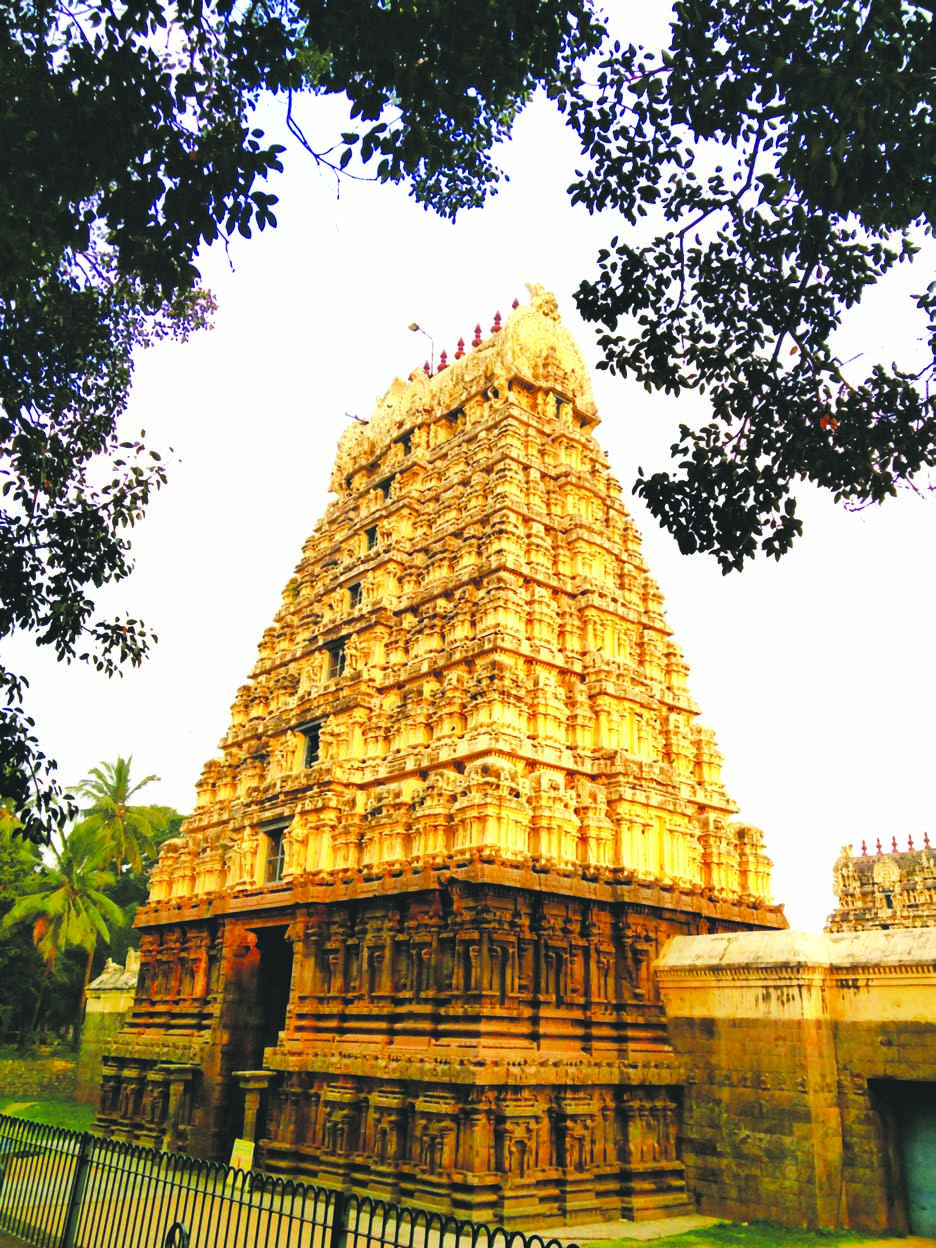
Jalakanteswarar Temple, a Beautiful Lord Shiva temple is below ground level to the north of the fort. It’s main shrine was an anthill surrounded by water, hence the name. The shrine faces the auspicious ‘east’ whereas the two Gopuras face south, these gopuras act as entrances to the two spacious parallel corridors – the corridors are rich with sculpted pillars and hall ways. The temple has a large maidan opposite to it. This is a lungspace forming a playground to the people of Vellore. The temple complex occupies 8,786 mts of area. It’s an art expose on display from the early 14th Century! The Towers are full of mythological historical sculpture. A divine sight to invoke your soul. The mantapas inside are a wonderful art, talent display at the best. These mantapas were earmarked surveyed, numbered, catalogued by the British to be dismantled and shifted to the London museum. But fate was on the Indian side, the ship which was to ferry sunk in the waters of bay of Bengal and the political scenario changed against the British!
This great Sri Jalakanteswarar Temple is a copied version of the original Jalakanteswarar Temple at Thiruvanaikaval (Trichy) built by the Cholas 1800 years ago. It’s one of the 5 elements temple – WATER! The scantum was an ant hill surrounded by water. It was replaced by a Shiva Linga. Hence the name meaning Lord Shiva Linga in Water, Sri Jalakanteswarar. This Temple was built by the Chieftain and the controller of the Fort, Chinna Bommu Nayakar. It was during the reign of the Vijayanagar King Sadashivadeva Maharaya (1540 – 1572 AD)
After the Muslim invaders took control of the Vellore Fort in 1650s till independent India, the fort had become a military bastion. The only way to enter was the draw bridge on the moat. Public and Devotees were not allowed into the fort, let alone entering and praying at the Sri Jalakanteswarar Temple. Hence this Temple was closed for more than 300 years. The British had used the temple premises as a storage arsenal area.
Archeological Society of India took over the control of the Fort in 1921 and resorted the fort and the surrounding areas including the temple. Mahatma Gandhi also visited the Vellore Fort in 1927.
ASI did not allow any religious rituals at the structure. It wanted to maintain a status quo as an historical edifice. However on 16th March1981 the people of Vellore smuggled the main diety of Sri Jalakanteswarar which was hidden at Jalakananda Vinayagar Temple at Sathuvachari and installed it at the original Vellore Fort premises.
The ASI nor the District Administration nor the Police could do anything fearing public outcry and riot. Rituals, poojas celebrations take place on a regular basis here. The Tamilnadu Government has taken over the temple from a private trust which existed for sometime.
The prayers of devotees at Sri Jalakanteswarar Temple are focused on . . . Longevity, freedom, fear from accidents, concluding marriages, evil eye (dhrusti). Faith and belief says they are answered. Worth being reverend, you got all to gain and nothing to lose! The uniqueness of the temple is… All the three Lord’s of Hinduism… Lord Shiva with Parvati, Lord Vishnu with Lakshmi and Lord Bhrama with Saraswati have Shrines and are worshipped here. ASI found 3 underground rooms in the temple premises, their deductions were they were present to hide the temple wealth. One of the underground rooms was below the temple well. The mystic secretive? tunnel leading out of the Vellore Fort to Virinjipuram 15 Kms away was never found. A golden chariot is used to take the deity around parts of old Vellore town. Today Vellore Fort area is a major lung space in the heart of town. The parks adjacent the moat on the periphery is a relaxation site.
It takes an hour or two to visit the temple and photograph in detail. I recommend early morning before sunrise.
It’s lucky we have the beautiful Mantapa out here, fate has intervened for us to take care of edifices of value. Let’s save it for the future generations.
-Jagdeesh Laxman Singh
aka Jugie Singh
Text & Photography
Vellore: Sri Jalakanteswarar Temple; A part would have been at London!