
 City Kemp News
Book Review
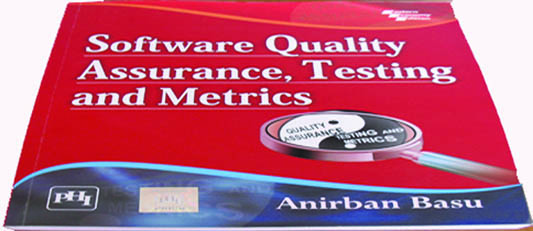
l “Software Quality Assurance, Testing and Metrics”
l By Dr Anirban Basu
l Publisher: PHI Learning
l Price: Rs. 295/-
The book “Software Quality A ssurance, Testing and Metrics” written by Dr Anirban Basu was released recently. The author who holds a Masters and PhD in Computer Science and has experience in Industry, academics, Research and Development and in corporate training. He is Vice President of Computer Society of India (2015-2016), the largest and oldest body of IT professionals in the country. He will take over as President of CSI in 2016 and is known to the residents of Koramangala as he was President of the Rotary Club of Bangalore Koramangala during 2009-10.
The book is written to help students of undergraduate, post graduate courses as well as IT professionals, in understanding different aspects of software quality engineering and discusses three fundamental aspects of Software Quality: Quality Assurance (QA) , Quality Control (QC) and Metrics in a simple, easy to understand manner.
The book consists of fourteen chapters and starts with basic concepts on different quality models, phases in software development, software development life cycle models, cost of poor quality, software configuration management etc.. Various QA standards such as ISO, CMMi, TMMi are covered in Chapter 2. Relevant aspects of Six Sigma methodology are also discussed in this chapter.
Chapter 3 discusses the importance of Reviews, Inspection and Walkthroughs, along with the roles of stakeholders in an inspection process. Some important inspection metrics are also discussed. Chapter 4 introduces the testing techniques used in different contexts. The book in Chapter 5 discusses different structural testing techniques. Integration testing, functional testing and non-functional testing are discussed in Chapters 6 to 8.
The book includes a chapter on Test automation covering current trends in test automation. Test Management, OO Testing, and Cloud Testing are also covered in the book. Chapter 13 covers the important topic of Software Metrics, while Chapter 14 discusses tools for quality improvement.
At the end of each chapter, Quizzes, Multiple Choice Questions and Review Questions have been added to facilitate understanding the contents. These also help in the international certification examinations.
While there are a number of books in the area of Software Quality and Testing, most of the books cover primarily theoretical concepts without discussing in details the practices followed in the industry.
This book is different and explains the contents in a lucid style. Tools used for each of the testing practices are also discussed. This helps a student passing out of an academic institution to know the concepts before joining the industry. The contents of the books help not only a student but an young IT professional who after joining the industry need to understand the concepts behind the work assigned to him/her.
The book is written without jargons and the thrust is on making readers know the subject and understand the fundamental concepts without much difficulty. It is very well recommended to both students as well as to IT professionals in knowing the subject of Software Quality.
The book is available in book stores in and around Koramangala


